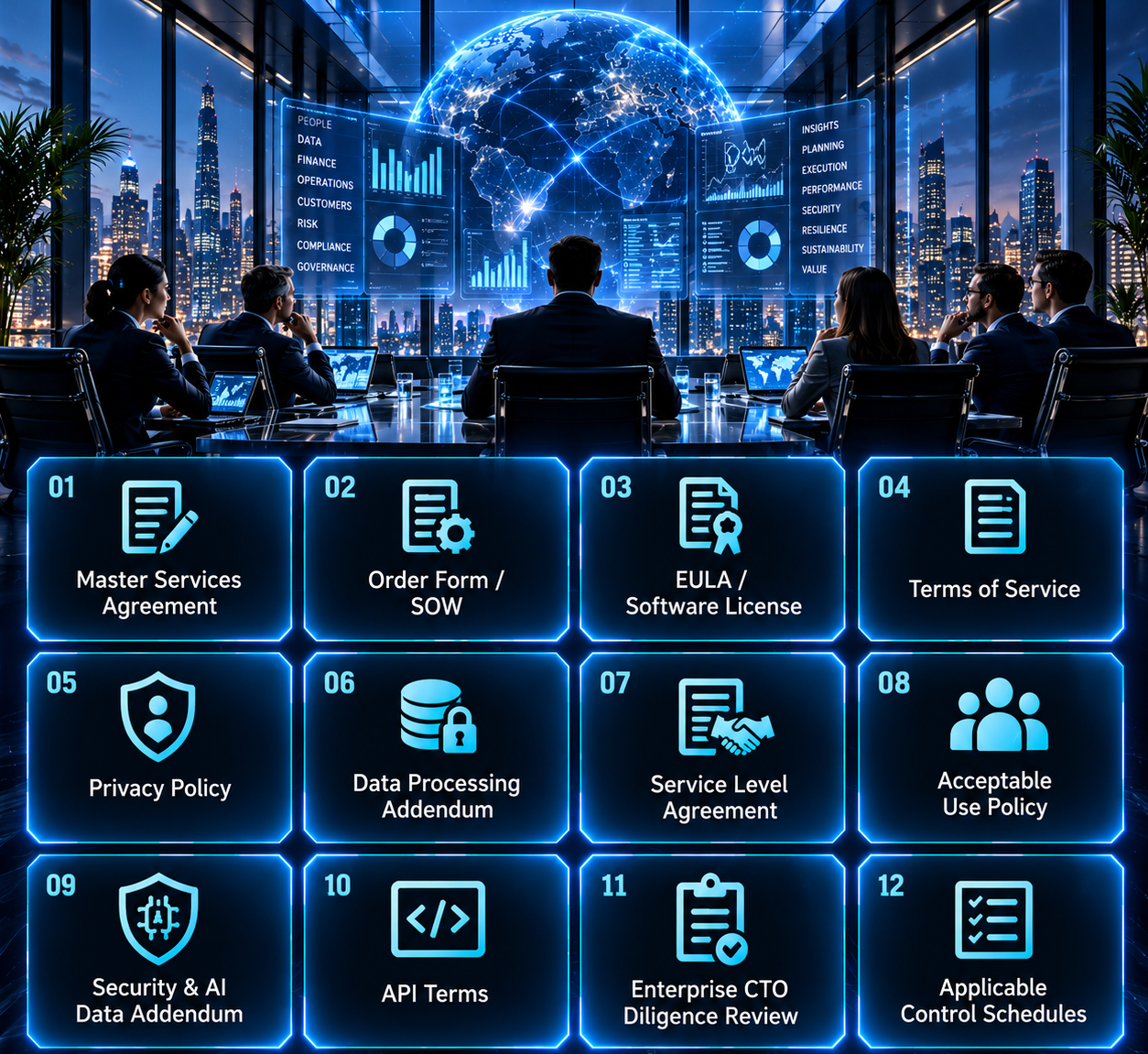
Thirteen coordinated domains
Security and governance across the complete intelligence lifecycle.
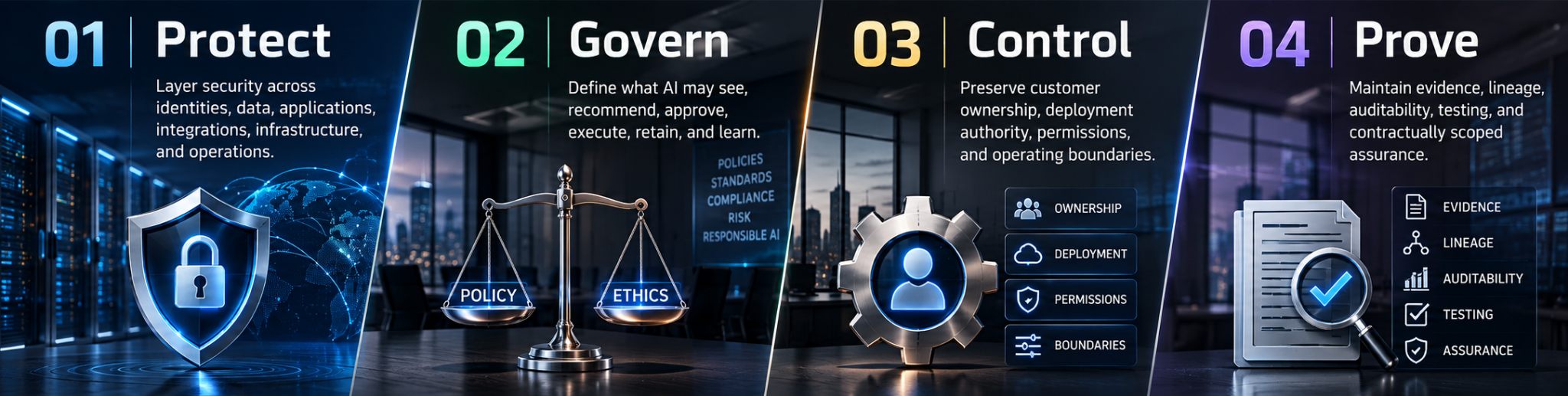
Each domain establishes a distinct layer of protection while operating as part of one customer-controlled enterprise framework.
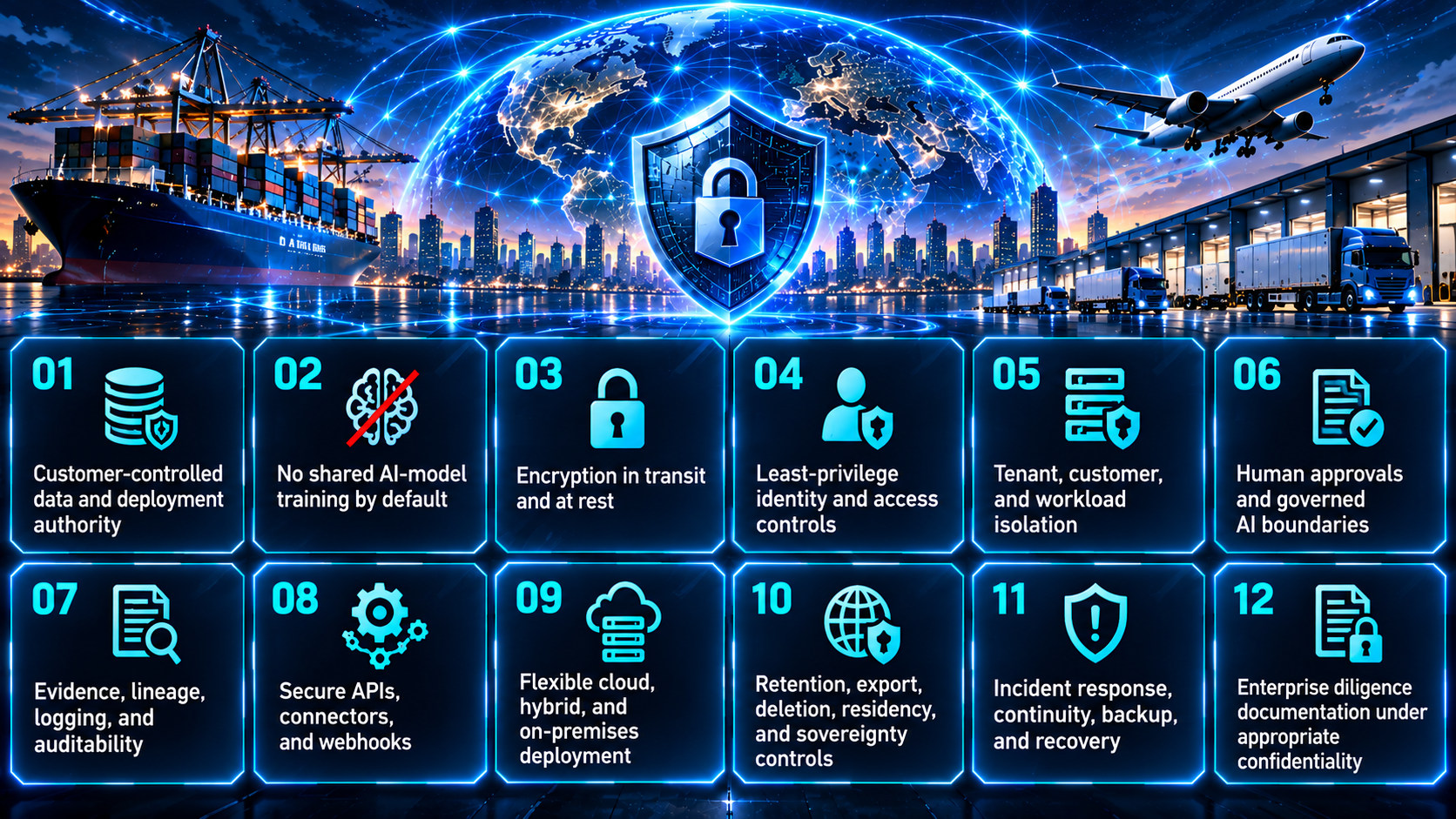
01Enterprise Data Protection & Access Security
MEGAMODAL's enterprise solutions are designed around layered access restrictions, secure connectivity, and traceable use of information.
- Encryption in transit and at rest, with documented encryption-key and secrets-management responsibilities.
- Tenant isolation, identity controls, least-privilege permissions, SSO/MFA where configured, RBAC, and ABAC.
- Row-, column-, and object-level access restrictions appropriate to the selected analytical environment.
- Data classification, retention controls, source lineage, provenance, and audit records.
- Private connectivity, restricted administrative access, and logged, revocable support access where applicable.
- Secure integration with ERP, MES, WMS, TMS, PLM, CRM, procurement, finance, spreadsheets, APIs, and external sources.
02Customer Ownership & Confidentiality
Customer information is not transferred to MEGAMODAL as unrestricted intellectual property. Customers retain rights in Customer Data and customer-specific outputs, subject to underlying platform technology and third-party rights.
- Customer Data includes source extracts, prompts, customer-specific outputs, mappings, configurations, knowledge-graph relationships, decision history, and audit records.
- Access and processing are limited to contracted services, security, support, legal requirements, and documented customer instructions.
- Customer-specific data is not sold or exposed to other customers under the standard contractual protections.
- Contractual export, return, and deletion rights apply at termination, subject to agreed export periods, backups, legal retention, and deployment responsibilities.
03No Shared AI Model Training by Default
Customer Data, prompts, and customer-specific outputs are not used to train, fine-tune, evaluate, or improve shared or third-party general-purpose AI models by default.
- Cross-customer learning from proprietary decisions, policies, or persistent memory requires a separately scoped written opt-in.
- Any optional use must define the data, purpose, recipients, retention, revocation, and applicable de-identification terms.
- Third-party inference providers and their training, retention, and geographic processing settings must be documented.
- Declining optional shared-model training does not disable the contracted core service.
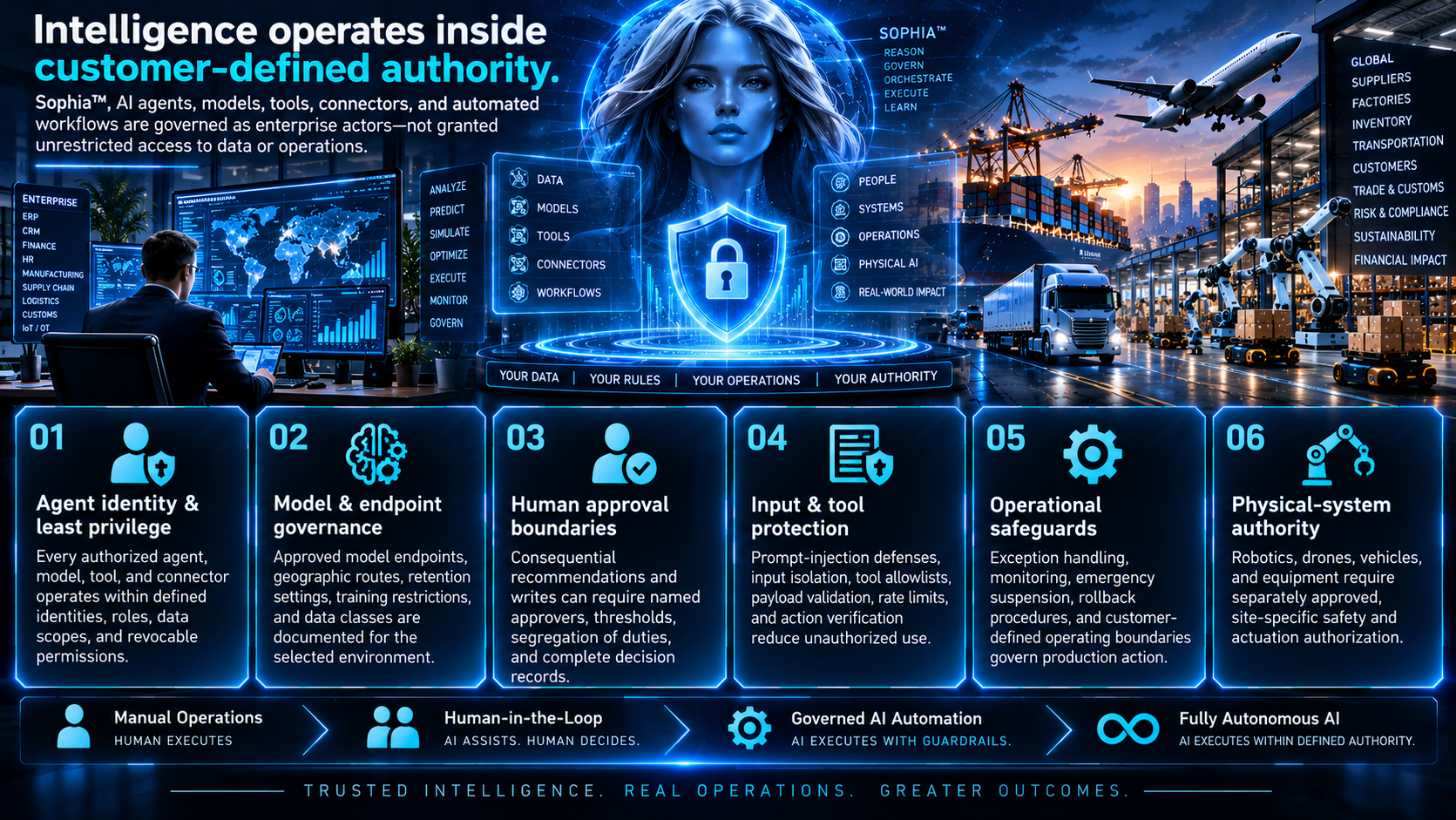
Sophia™, Archons, AI Engines, Copilots, and Workflow Agents operate across authorized information while respecting organizational permissions and evidence boundaries. MEGAMODAL distinguishes source facts from forecasts, simulations, recommendations, and authorized actions.
- Four governance modes: Manual Operations, Human-in-the-Loop, Governed AI Automation, and Fully Autonomous AI—each subject to configuration and authorization.
- Advisory-only behavior is the default until production action permissions and approval policies are expressly documented.
- Consequential writes require approved workflow authority, including procurement commitments, inventory changes, partner communications, or financial postings.
- Controls include tool allowlists, prompt-injection defenses, input isolation, action verification, thresholds, audit trails, exception handling, and documented stop/rollback procedures.
- Robotics, drones, vehicles, and physical equipment require separate site-specific safety authorization; simulation alone does not authorize live actuation.
05Secure Software Development & Independent Testing
Engineering security specifications address protection across the software lifecycle and establish measurable acceptance expectations before relevant production activation.
- Secure code review, dependency and software bill-of-materials inventories, vulnerability scanning, patching, and controlled releases.
- Testing of cross-tenant access, privilege escalation, API abuse, prompt injection, and fail-safe behavior.
- Documented remediation and acceptance of critical or high findings—or approved exceptions.
- Security evidence and testing scope may be reviewed under appropriate confidentiality and enterprise diligence procedures.
06API, Webhook & Connector Security
MEGAMODAL solutions connect and orchestrate across existing systems through controlled, documented interfaces rather than unrestricted access.
- Scoped credentials, service identities, least-privilege read/write access, key rotation, and revocation.
- Authenticated or signed webhooks, replay protection, rate limits, and payload validation.
- Idempotent writes where supported, correlation identifiers, safe retry rules, and downstream reconciliation.
- Per-connector ownership, permissions, source-of-truth rules, and recovery responsibilities.
07Privacy & Global Regulatory Governance
The framework supports deployment-specific obligations under relevant privacy and regulated-data laws, distinguishing MEGAMODAL’s controller role for its own records from its processor or service-provider role for Customer Personal Data.
- SOC 2-aligned security controls; independent SOC 2 attestation must be confirmed separately.
- GDPR-oriented processing terms, data-subject request support, international transfer mechanisms, and sub-processor oversight.
- CCPA/CPRA service-provider restrictions on unauthorized sale, sharing, combining, or secondary use of Customer Personal Data.
- HIPAA-oriented safeguards for applicable healthcare workloads; regulated health data requires approved scope, controls, and any necessary Business Associate Agreement.
- Data residency, sovereignty, authorized support regions, and transfer documentation according to the selected deployment.
08Third-Party Vendor & AI Data-Flow Governance
Customers should know which service providers and model endpoints can receive their information and for what purpose.
- Documented sub-processor and AI-model registers identify service, purpose, data classes, processing locations, and relevant safeguards.
- Contractual restrictions govern training, retention, and onward processing.
- Review, notice, and objection mechanisms apply to relevant sub-processor changes under the DPA.
- Material changes to model endpoints or data routes require applicable change-control and authorization procedures.
09Incident Response, Business Continuity & Recovery
The framework provides for security escalation, investigation, containment, remediation, evidence preservation, and customer cooperation. Actual commitments are established in signed schedules.
- Security-incident and personal-data-breach notification under the applicable Security Addendum and DPA.
- Severity-based support, incident records, escalation channels, and post-incident review.
- Encrypted backups, restoration runbooks, restore testing, and documented recovery-point and recovery-time objectives where agreed.
- Hosted availability targets and service credits only where selected and validated in the signed SLA.
- Customer-hosted recovery, infrastructure, and backup responsibilities are separately allocated.
10Customer Data Lifecycle & ‘No Data Holding’ Principle
MEGAMODAL emphasizes data minimization, customer control, and federated access where appropriate. ‘No Data Holding’ means avoiding unnecessary persistence—not that no information is ever processed or stored.
- Processing, temporary caching, logs, prompts, memory, outputs, decision records, backups, and vendor-held copies follow configured retention policies.
- Export and return or deletion procedures are governed by the MSA, DPA, and Security Addendum.
- Customers may request deletion evidence where required by signed terms.
- Customer-hosted deployments assign local data removal to the customer and Provider-controlled copies to MEGAMODAL as contracted.
11Application & Browser Security
Application protections complement identity, network, API, and infrastructure controls.
- HTTP Strict Transport Security for secure browser connections.
- Content Security Policy to restrict unauthorized resources.
- X-Content-Type-Options to limit MIME sniffing.
- Referrer-Policy to control referrer disclosure.
- X-Frame-Options to help mitigate clickjacking.
12AWS & Flexible Deployment — Shared Responsibility
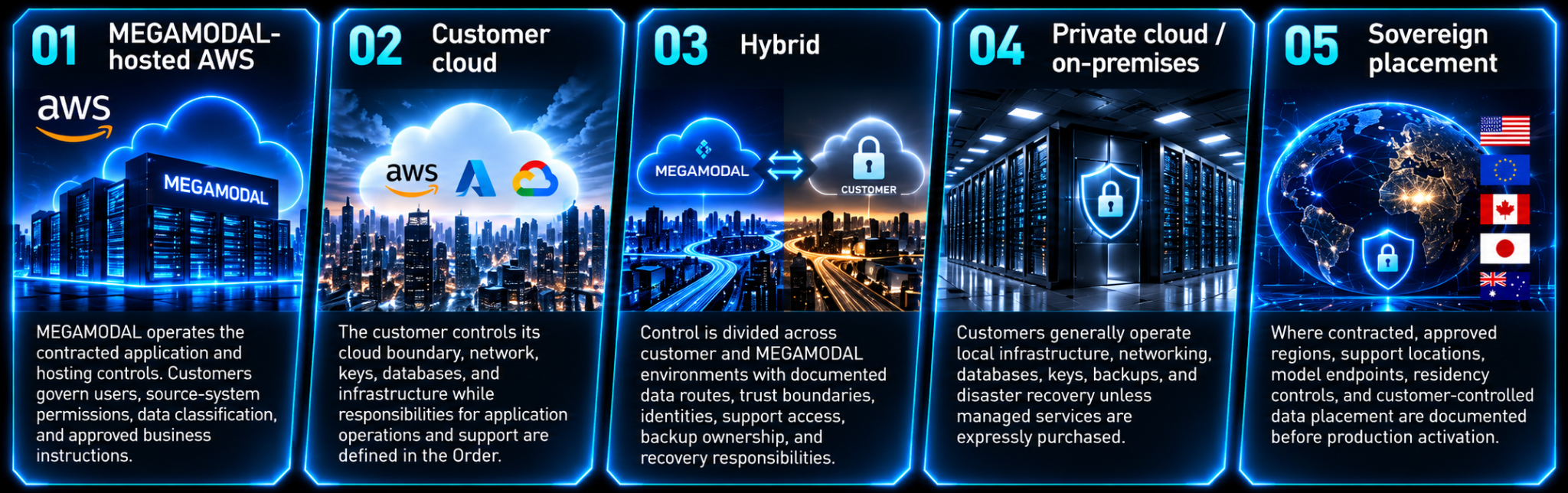
The security and shared-responsibility framework applies across Analytics OS™, MEGAMODAL ONE™, MEGAMODAL™ Layered Super Intelligence, and MEGAMODAL OS™. The solutions support AWS-based deployment and, where contracted, hybrid, private-cloud, customer-controlled, and on-premises configurations. AWS capabilities support secure deployment but do not automatically confer AWS certifications on MEGAMODAL.
- Provider-hosted services: MEGAMODAL manages contracted application and hosting controls; customers remain responsible for users, source systems, permissions, and approved business instructions.
- Customer-hosted deployments: customers generally operate infrastructure, network, databases, keys, backups, and disaster recovery unless managed services are expressly purchased.
- Production regions, backup locations, remote support routes, model endpoints, and responsibilities are documented in Order and security schedules.
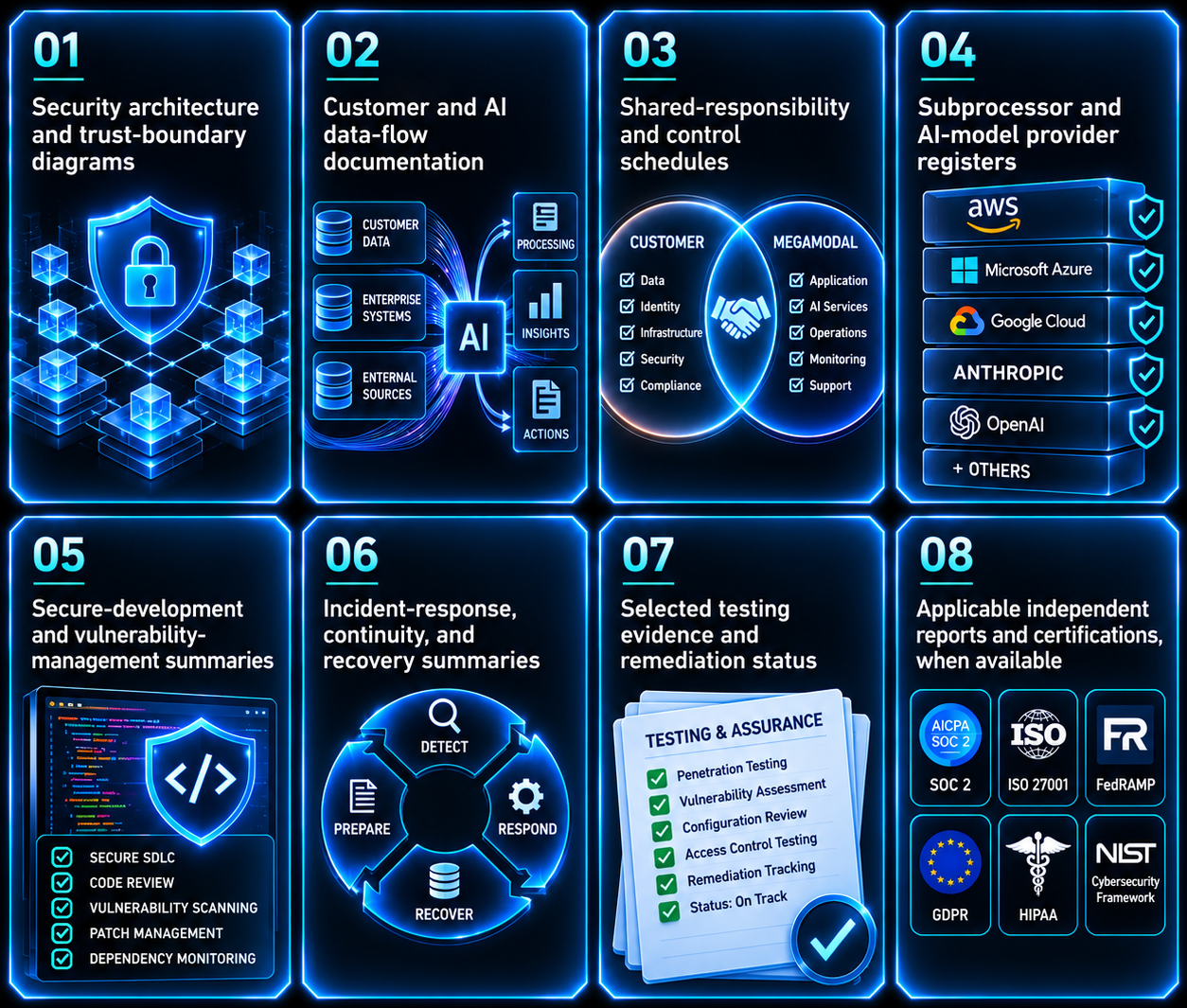
13Customer Security Diligence & Assurance
The contractual package provides a structure for enterprise procurement, security, and CTO review, with relevant evidence available under appropriate confidentiality.
- Customers may request completed control schedules, subprocessors, data-flow maps, selected testing evidence, and applicable independent reports if available.
- Signed scope and control schedules identify which protections are active, who operates them, and how they are tested.
- Security, privacy, AI, and deployment commitments are linked to the purchased product, data classes, and environment.
- Independent certifications, exact uptime figures, and recovery targets are represented only when supported by current evidence and applicable signed terms.