
01–05
Architecture & Transformation
Choose an architectural destination that can progressively reduce fragmentation—not simply another layer that depends on it forever.
Chief Information Officer
The comparison ultimately condenses into fifteen strategic considerations spanning architectural destination, transformation strategy, platform economics, decision intelligence, governed autonomy, customer rights, and enterprise convergence.
The decision framework
MEGAMODAL is designed around the complete enterprise journey: improve the technology already trusted, control the pace of AI adoption, and preserve a credible path toward operating-system consolidation.
Choose an architectural destination that can progressively reduce fragmentation—not simply another layer that depends on it forever.
Make enterprise intelligence more accessible, economically predictable, and easier to justify through measurable operational outcomes.
Improve decisions before execution, connect digital intelligence to physical operations, and advance toward autonomy under explicit enterprise control.
Protect the intelligence created around the customer’s enterprise while converging systems, knowledge, governance, and execution into one future-ready environment.
Strategic considerations 01–05
Choose an architectural destination that can progressively reduce fragmentation—not simply another layer that depends on it forever.
MEGAMODAL OS provides a native operating-system destination. Based on publicly demonstrated capabilities, Happy Robot has not shown an equivalent path for replacing fragmented ERP, TMS, WMS, and related enterprise systems.
Layer intelligence above trusted systems today, then selectively migrate functions tomorrow through one coordinated architectural roadmap.
Go beyond making disconnected systems communicate better. Create a controlled pathway for retiring selected fragmentation as functions migrate into a unified operating environment.
Progressively converge enterprise data, knowledge, memory, AI, workflows, governance, and execution within one coordinated intelligence architecture.
Reduce perpetual dependence on connectors, APIs, mappings, middleware, and synchronization wherever fragmented functions migrate natively into MEGAMODAL OS.
Strategic considerations 06–09
Make enterprise intelligence more accessible, economically predictable, and easier to justify through measurable operational outcomes.
Create entry points for organizations that cannot justify a quarter-million-dollar-class initial AI commitment, then scale investment with enterprise requirements.
Structure enterprise intelligence around transparent licensing and compute economics rather than making every intelligent action feel like another unpredictable meter.
A lower initial investment means less operating improvement is required before the customer reaches economic justification and begins realizing net value.
MEGAMODAL OS creates the potential for technology consolidation in addition to AI productivity—unlocking value through both operational improvement and platform simplification.
Strategic considerations 10–12
Improve decisions before execution, connect digital intelligence to physical operations, and advance toward autonomy under explicit enterprise control.
Simulate alternatives, quantify tradeoffs, and improve decisions before execution—not only accelerate actions after the decision has already been made.
Extend enterprise intelligence toward robotics, automated systems, IoT and edge devices, augmented reality, facilities, autonomous transportation, and other physical operations.
Advance workflow by workflow through four clearly defined modes: Manual Operations → Human-in-the-Loop → Governed Automation → Full Autonomy.
Strategic considerations 13–15
Protect the intelligence created around the customer’s enterprise while converging systems, knowledge, governance, and execution into one future-ready environment.
Establish clear contractual ownership and portability principles for the enterprise-specific knowledge, context, memory, and operating intelligence the AI develops for each customer.
Match the transformation path to the customer’s readiness: MEGAMODAL Core → Supreme → MEGAMODAL OS → Enterprise OS → Customized Enterprise Platform.
Progressively bring systems of intelligence, record, execution, applications, data, knowledge, governance, and autonomy into one AI-native operating environment.
Lifetime platform economics
The difference is not simply what the AI can do today—it is what happens to the cost and complexity of the underlying technology estate over time.
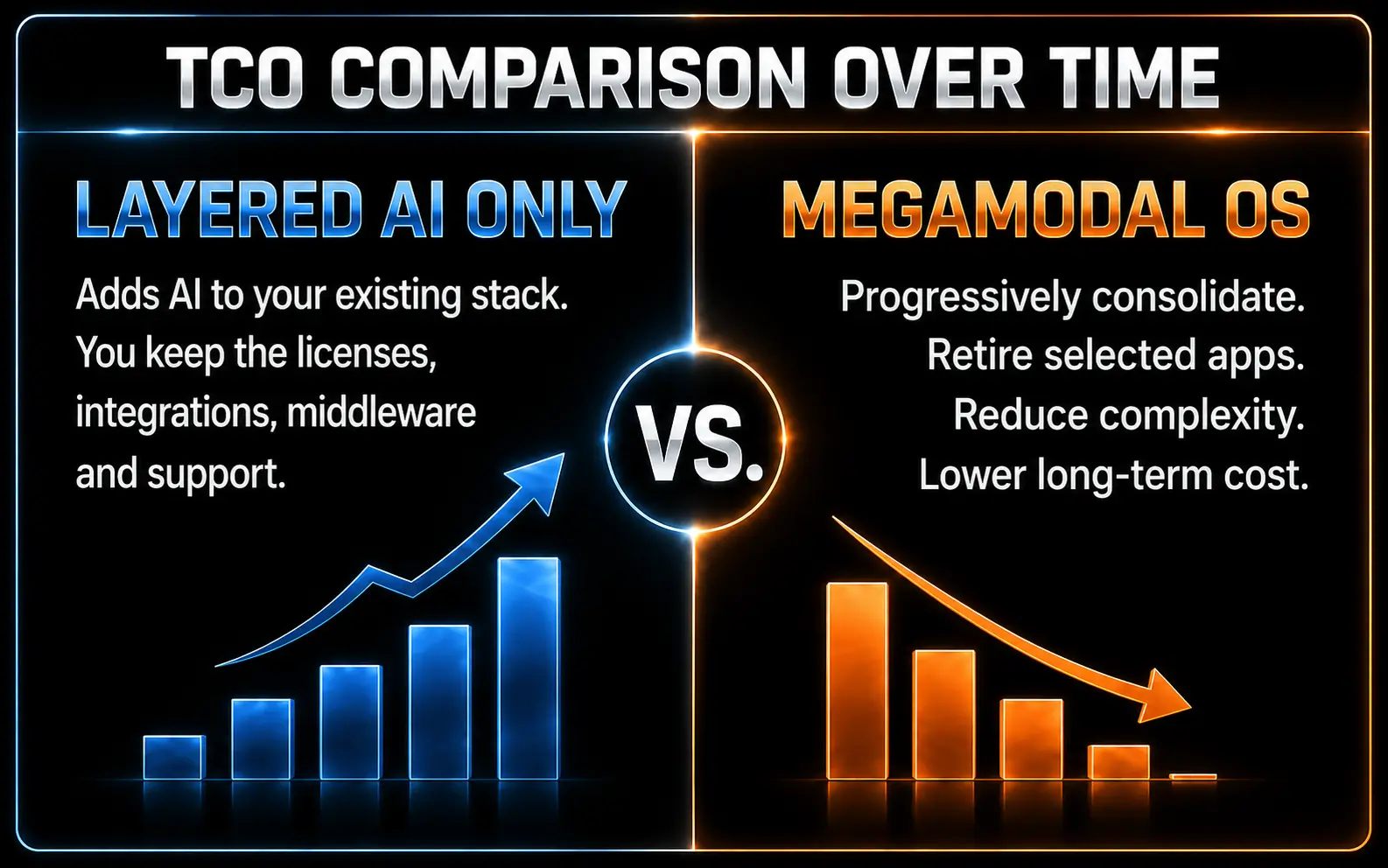
Layered AI is often the fastest and least disruptive starting point. It connects ERP, TMS, WMS, CRM, and other applications while adding enterprise reasoning, visibility, orchestration, and governed execution without forcing an immediate replacement project. But the intelligence is still operating above a fragmented technology estate, so the customer continues carrying the licenses, maintenance agreements, middleware, integration mappings, data synchronization, upgrade cycles, infrastructure, vendor coordination, and support obligations of the underlying systems.
MEGAMODAL OS changes the long-term cost model. As capabilities migrate into the AI-native operating system, the customer can progressively retire selected point solutions, connectors, duplicate data stores, and support dependencies—function by function and at a controlled pace. This is not a disruptive big-bang replacement. It is an orderly convergence roadmap designed to preserve business continuity while reducing complexity, integration debt, and recurring technology spend over time.
TCO includes far more than the AI subscription: software licensing, annual maintenance and support, middleware, integration engineering, cloud or on-premise infrastructure, security, upgrades, internal administration, downtime risk, and the cost of coordinating multiple vendors.
MEGAMODAL supports both destinations. Organizations can begin with Layered Super Intelligence for near-term improvement, then transition selected functions to MEGAMODAL OS when the operational and economic case is right—turning today’s intelligence investment into a pathway toward long-term enterprise convergence.
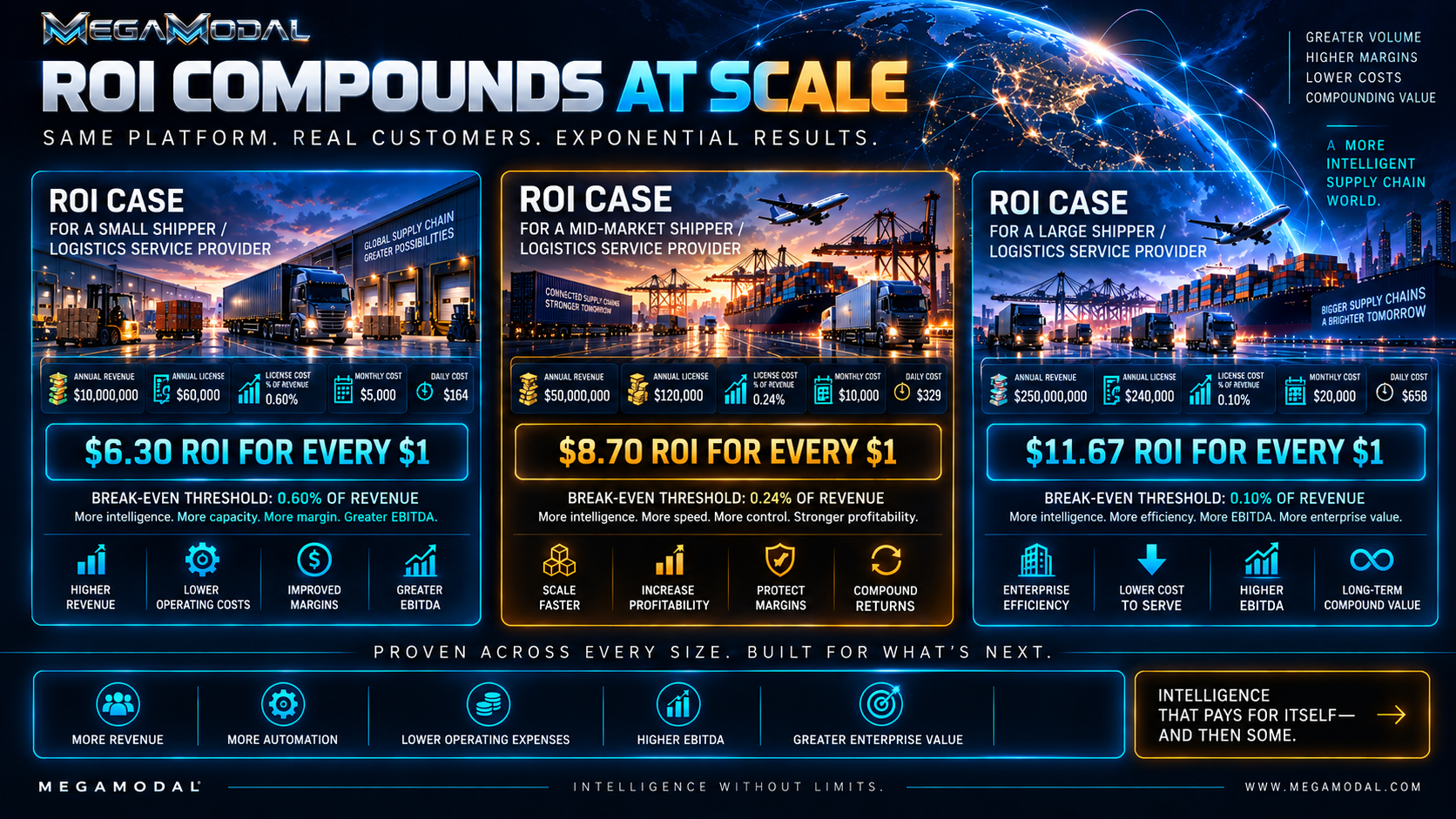
Illustrative scenarios for strategic planning. Actual results vary by baseline performance, deployment scope, adoption, and execution.
Choose the destination
MEGAMODAL gives enterprise leaders one commercial and architectural ladder—from accessible layered intelligence to a native, customer-controlled operating environment.
Competitive observations are based on publicly available product information and MEGAMODAL’s current platform packaging. Competitor capabilities, pricing, and commercial terms may change; prospective customers should validate requirements against current offerings.